Espresso vs Cappuccino vs Latte: The Complete Guide to Every Café Drink
This post may contain affiliate links. See our disclosure policy for details.
In eight years behind an espresso bar, the question I answered more than any other wasn’t “how do you make this?” — it was “what’s the difference between these?” Espresso, cappuccino, latte, macchiato, cortado, flat white — the menu at any coffee shop can feel like a foreign language if you don’t know what’s behind each name.
Let me clear it up. All of these drinks start from the same base: a shot (or two) of espresso. The differences are entirely about how much milk you add, what texture that milk has, and the ratio of coffee to milk. Once you understand that framework, the whole menu makes sense instantly.
What Is Espresso?
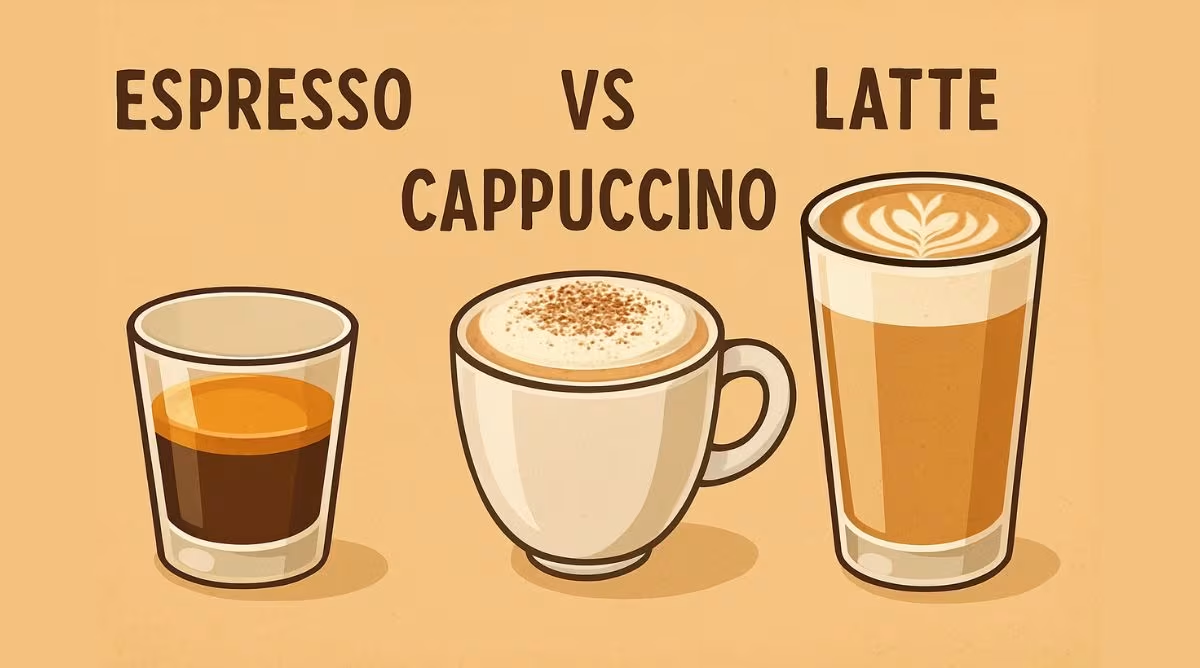
Espresso is the foundation of every drink on this list, so let’s start here. Espresso is made by forcing hot water (92–96°C / 197–205°F) through finely ground, tightly packed coffee at approximately 9 bars of pressure, over 25–30 seconds. This produces roughly 30–40ml of concentrated coffee with three distinct layers:
- Crema: The reddish-brown foam on top, made of emulsified coffee oils and CO₂. It carries intense aroma and contributes to mouthfeel.
- Body: The dark brown middle layer — the main liquid.
- Heart: The darkest, most intense bottom layer.
A single shot of espresso is approximately 30ml and contains 60–70mg of caffeine. A double shot (doppio) — the standard in most US specialty cafés — is 60ml with 120–140mg of caffeine. Espresso has a higher caffeine concentration per ml than drip coffee but is consumed in much smaller volumes, so total caffeine intake is comparable or lower.
How it tastes: Bold, concentrated, complex. Good espresso has sweetness, acidity, and bitterness in balance — not just bitterness. If your espresso is only bitter, either the grind is too fine, the extraction is too long, or the beans aren’t fresh.
When to order it: When you want the full flavor of the bean with nothing diluting it. Also the base of every milk drink below.
What Is a Cappuccino?
A cappuccino is traditionally a 6oz drink built in thirds: one part espresso, one part steamed milk, one part dense milk foam. The traditional Italian cappuccino is specifically a breakfast drink — in Italy, ordering a cappuccino after 11am is considered a cultural faux pas (though that rule is ignored outside Italy).
The classic recipe (6oz / 180ml):
- 1–2 shots espresso (30–60ml)
- ~60ml steamed milk
- ~60ml dense, dry microfoam (thicker than latte foam)
The defining characteristic of a cappuccino is the foam — it should be dense and thick, holding its shape. When made correctly, you can spoon it out. This is different from the velvety microfoam in a latte, which is silkier and more integrated with the milk.
Wet vs. Dry cappuccino: A “wet” cappuccino has more steamed milk and less foam (closer to a latte). A “dry” cappuccino has less milk and more foam. If you order a cappuccino and want to specify, these are the terms to use.
How it tastes: The high foam-to-milk ratio means the espresso flavor is more prominent than in a latte. You taste the coffee more clearly. The foam’s texture creates a light, airy experience on top, then the denser espresso hits beneath.
Caffeine: Typically one or two shots — 60–140mg depending on the shop’s standard.
What Is a Latte?
A latte (short for “caffè latte” — Italian for “coffee with milk”) is espresso topped with a much larger proportion of steamed milk and a thin layer of microfoam. Where a cappuccino is roughly equal thirds, a latte is typically 1 part espresso to 3–4 parts milk.
The classic recipe (12oz / 355ml, the most common size in US cafés):
- 2 shots espresso (60ml)
- ~270ml steamed milk
- ~5–10mm thin layer of microfoam on top
The microfoam in a latte is silky and velvety — almost liquid in texture — and is the canvas for latte art. A good barista incorporates the foam fully into the milk rather than leaving a thick foam cap.
How it tastes: Much milder than a cappuccino. The high milk content rounds out the espresso’s intensity, creating a creamy, sweet cup where the coffee flavor is present but not dominant. It’s the most approachable espresso drink for people who are new to coffee or prefer a milder taste.
Caffeine: Typically two shots — 120–140mg. Note that the larger volume of milk doesn’t dilute the caffeine — the caffeine content is in the espresso only.
Full Comparison: Espresso vs Cappuccino vs Latte
| Drink | Volume | Espresso | Milk | Foam Type | Coffee Intensity | Caffeine |
|---|---|---|---|---|---|---|
| Espresso | 1–2oz (30–60ml) | 100% | None | Crema only | Very high | 60–140mg |
| Cappuccino | 5–6oz (150–180ml) | 1/3 | 1/3 steamed + 1/3 foam | Dense, dry foam | High | 60–140mg |
| Latte | 8–16oz (240–480ml) | ~1/4–1/5 | ~3/4 steamed + thin foam | Silky microfoam | Mild | 120–140mg |
| Flat White | 5–6oz (150–180ml) | ~1/3 | ~2/3 steamed, minimal foam | Very thin microfoam | Medium-high | 120–140mg |
| Macchiato | 2–3oz (60–90ml) | ~2/3 | Small dollop foam | Small foam “stain” | Very high | 60–140mg |
| Cortado | 4oz (120ml) | 1/2 | 1/2 steamed, no foam | Minimal/none | High | 120–140mg |
The Other Drinks You’ll See on the Menu (Explained Simply)
Flat White
Originating in Australia/New Zealand, the flat white is essentially a small latte with a higher coffee-to-milk ratio and a very thin layer of microfoam — hence “flat.” At 5–6oz with typically two ristretto shots (shorter, more concentrated espresso), it delivers a stronger coffee experience than a standard latte but in a smaller, more elegant package. If you want a latte but stronger, order a flat white.
Macchiato
The traditional Italian macchiato (caffè macchiato) is just a shot of espresso “stained” (macchiato = stained) with a small dollop of foam. It’s 2–3oz total — barely a few sips. Don’t confuse this with a Starbucks Macchiato, which is a very different drink (essentially a latte with caramel poured on top, built upside-down). If you order a macchiato at a specialty café, you’ll get the small traditional version.
Cortado
A cortado is a 4oz drink — equal parts espresso and steamed milk (no foam). The name comes from the Spanish “cortar” (to cut) — the milk “cuts” the espresso’s acidity. It’s a great middle ground: stronger than a flat white, more balanced than a straight macchiato, and doesn’t have the foam texture of a cappuccino.
Americano
An Americano is espresso diluted with hot water to approximate the volume and strength of drip coffee. Two shots + 6–8oz of hot water = a 8–10oz Americano. It has a similar caffeine content to a cup of drip but a distinctly different flavor profile — espresso-extracted coffee has different compounds than drip-brewed coffee.
How to Choose What to Order
- Want pure coffee flavor, nothing else? → Espresso or Americano
- Want strong coffee with just a touch of milk? → Macchiato or Cortado
- Want strong coffee flavor in a small milk drink? → Cappuccino or Flat White
- Want something creamy and mild? → Latte
- Want something sweet? → Latte with flavored syrup (vanilla, caramel, hazelnut)
- New to espresso drinks? → Start with a latte. It’s the most forgiving and approachable.
Frequently Asked Questions
Does a latte have more caffeine than a cappuccino?
Not necessarily — it depends on how many shots are used. A standard cappuccino and a standard small latte both typically use one or two shots of espresso, giving both about 60–140mg of caffeine. The extra milk in a latte doesn’t add any caffeine. Where you see caffeine differences is in the size: a 16oz latte at Starbucks uses 2 shots; if you order a 12oz, it’s 1 shot. Always ask how many shots your drink contains if caffeine is a concern.
What makes cappuccino foam different from latte foam?
The difference is in the foam texture, controlled by how much air is incorporated during steaming. Cappuccino foam is “drier” — more air is introduced, creating a thicker, stiffer foam that holds its shape and can be spooned out. Latte microfoam is “wetter” — less air, more of a silky liquid texture that integrates smoothly with the milk and creates a homogenous, velvety cup. Both start with the same milk; the barista’s steaming technique determines the texture.
Can I use non-dairy milk for lattes and cappuccinos?
Yes — and some non-dairy milks actually steam and foam excellently. Oat milk (particularly Oatly Barista Edition or Minor Figures) is considered the gold standard for steaming — it creates microfoam nearly indistinguishable from dairy. Barista-formulated almond milk also works well. Regular grocery-store almond or oat milk (not barista editions) often separates or doesn’t foam properly. If you’re using non-dairy milk at home, specifically look for “barista edition” versions.
Why does my espresso taste bitter?
Espresso bitterness almost always indicates over-extraction. The main causes: grind too fine, extraction too long (more than 32 seconds), water too hot (above 96°C), or tamping too hard. Start by adjusting your grind slightly coarser and see if the bitterness reduces. Also check that you’re using fresh beans — stale beans often produce harsh, one-dimensional bitterness regardless of technique.
What’s the difference between a latte and a flat white?
Size and ratio, primarily. A flat white is smaller (5–6oz) with a higher espresso-to-milk ratio than a standard latte (10–16oz). Flat whites often use ristretto shots (shorter, sweeter espresso extraction) and have a thinner microfoam layer. The result is a more coffee-forward, smaller drink. Think of a flat white as a concentrated, elegant latte.
Final Thoughts
The espresso menu is simple once you see the pattern: espresso base → add milk → the amount and texture of that milk defines the drink. More foam = cappuccino. More liquid milk = latte. Less of both in a small drink = flat white or macchiato. Once that clicks, you can order confidently at any café in the world.
My personal daily order: a double cortado in the morning for the strong coffee hit, and a flat white in the afternoon when I want something with more milk but still punchy. But the best drink is always the one you actually enjoy — don’t let anyone tell you there’s a wrong answer.